

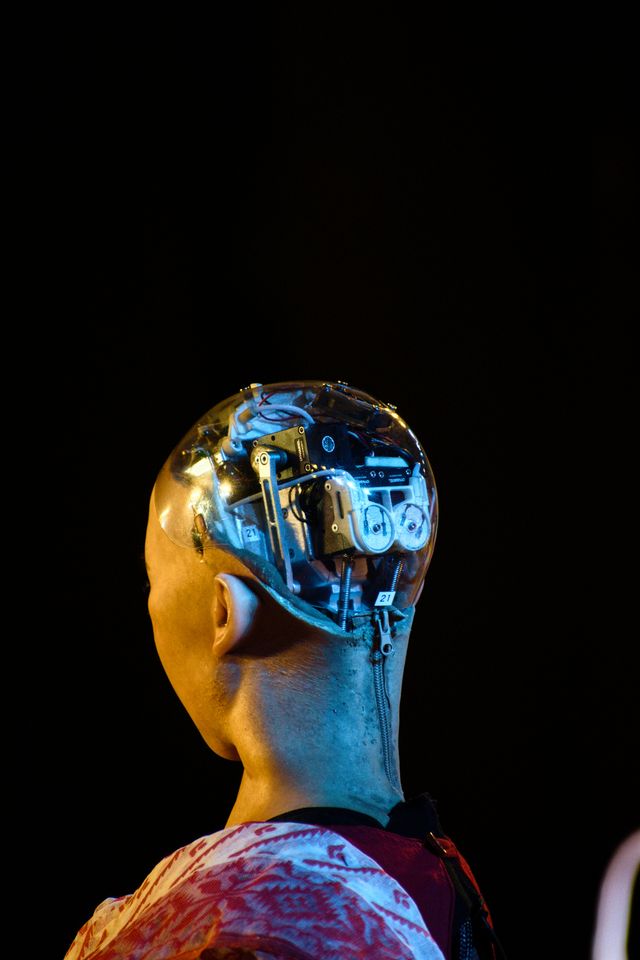
The line between your brain and computers is getting blurry. For a long time, brain-computer interfaces (BCIs) only existed in research labs. But that’s changing fast. Better manufacturing, new materials like graphene, and smarter AI are making BCIs a real technology. Now it’s worth understanding what these devices actually do, what they could do in the future, and the big questions we need to ask about them.
Helping People Walk Again and Move Their Bodies
Let’s start with the most important part, helping people who cannot move. Millions of people live with paralysis, spinal cord injuries, or conditions like ALS. For these people, BCIs are not science fiction. They are life-changing tools right now.
Here’s how it works. A small chip gets placed on the brain’s motor cortex, the area that controls movement. When you think about moving your arm, the chip picks up those signals. Then it sends them to a computer or robotic device. So even though the person’s body cannot move, their thoughts can control things.
Neuralink has shown this with their N1 chip. It has about 1,000 channels, basically 1,000 tiny sensors. Patients with paralysis used it to control computer cursors, type messages, and even play video games. Just by thinking about it.
There’s another approach that’s less invasive. Synchron developed something called a Stentrode. Doctors put it in through a vein in your neck instead of doing brain surgery. It reaches the motor cortex without needing to open the skull. This is especially helpful for people with ALS because it doesn’t require a major operation.
The point is simple: these devices give paralyzed people back some independence. They can communicate. They can work. That’s huge.
Future BCIs Could Make Brains Faster and Smarter
Now here’s where it gets interesting, and complicated. Medical use is happening today. But scientists are already thinking about tomorrow.
What if BCIs could do more than just read brain signals? What if they could send information back into your brain? This is still mostly theoretical, but researchers are exploring it.
If this works, BCIs could change how we learn and talk. Imagine:
Talking without your mouth. Your brain could send thoughts directly to other people’s devices. No typing. No speaking. Just instant sharing of complex ideas.
Learning faster. Your brain learns best through repetition and practice. But what if a BCI could help your brain form new connections more efficiently? You could potentially learn complex skills much faster than normal.
Controlling complex systems with your mind. You could navigate huge databases or industrial systems just by thinking. No mouse. No keyboard.
Again, this is mostly future talk. It’s not happening yet. But the research is real, and that’s why people are paying attention.
The Really Hard Questions We Need to Answer
Here’s the part that keeps ethics experts awake at night: if BCIs get really good, who gets them?
Right now, these devices are expensive. Only rich people could afford them. That creates a problem. If you have money, you can get a brain enhancement. If you don’t, you cannot. Over time, this could create two different classes of humans, enhanced and non-enhanced. That’s a problem for society.
There’s also the AI issue. If a BCI is constantly reading your thoughts and filtering information to you, who’s really in control? You or the machine? When AI interprets what your brain is doing, things get murky. The line between your choice and the machine’s choice blurs. That’s a governance problem that governments need to solve now, not later.
Security is another huge concern. These devices connect your brain to the internet. If hackers get in, they are messing with your thoughts. That’s not like stealing your passwords. That’s invading your mind. We need serious security standards before millions of people have brain chips.
There’s also the question of who owns your brain data. Your thoughts are basically data now. Should the company that makes the BCI own it? Should you own it? Should the government regulate it? These questions don’t have clear answers yet.
So What’s the Reality?
Brain-computer interfaces are real. They are helping paralyzed people today. The future possibilities are exciting, and also scary.
The key is getting the balance right. We cannot move so slowly that people who could benefit have to wait decades. But we also cannot move so fast that we create serious problems. We need smart regulations. We need to think about fairness. We need to protect people’s brains from hacking.
The technology is coming. The question is: are we ready for it?
Staying Current on Brain-Computer Interface News
This field is moving incredibly fast. New breakthroughs happen constantly. If you want to understand how BCIs fit into the bigger picture of automation and AI, check out our AI automation tools guide. For the latest updates on brain-computer interface technology and where it’s headed, bookmark our latest technology news section. The future is being written right now, and it’s worth paying attention to.


Global Deepfake Regulation and AI Governance
Artificial intelligence has rapidly evolved from a creative tool into a critical...
 Beatriz3 Mins read

What Is Pushwiki.com? Features and Content Guide
The online information space is incredibly crowded. Many users struggle to find...
Beatriz2 Mins read

Typeless AI Review: Features, Pricing, and Pros
The market for speech-to-text applications has evolved far beyond raw phonetic transcription....
Beatriz3 Mins read

Top Quantum Computing Breakthroughs of 2024
For decades, the conversation surrounding quantum computing focused almost entirely on raw,...
Beatriz3 Mins read





Leave a comment