

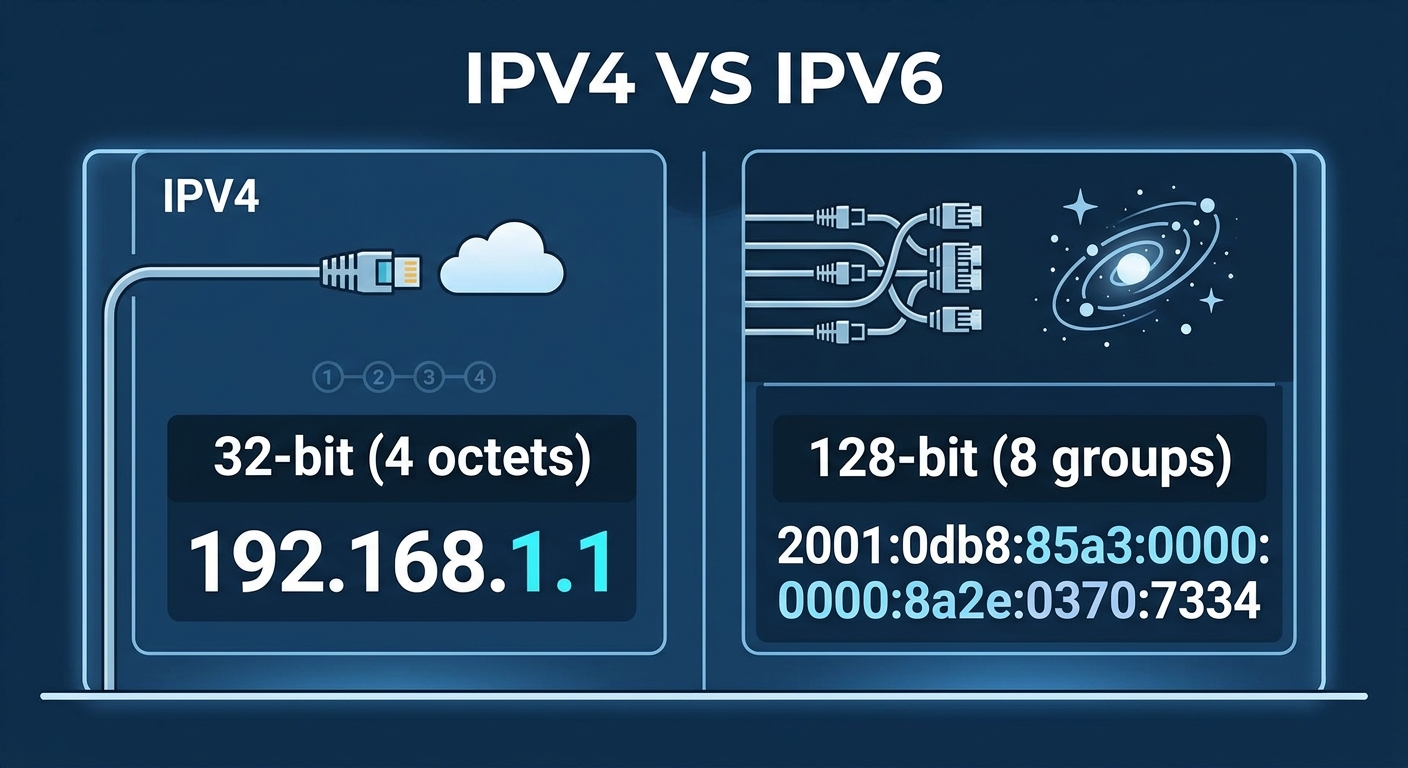
Every device connected to the internet requires a unique numerical address to communicate, route data packets, and access online services. For decades, the global internet ran almost exclusively on Internet Protocol version 4. However, the rapid proliferation of smartphones, cloud infrastructure, and smart IoT devices quickly exhausted the available addressing space.
Evaluating the ongoing transition of IPv4 vs IPv6 reveals critical differences in address capacity, routing efficiency, network security protocols, and operational costs.
Core Technical Differences: How They Work
The fundamental distinction between IPv4 and IPv6 lies in address length, notation structure, and packet header design:
- Address Space: IPv4 uses a 32-bit address format expressed in dotted decimal notation (e.g., 192.168.1.1), yielding approximately 4.29 billion total theoretical addresses. In contrast, IPv6 utilizes a 128-bit address format written in hexadecimal colon notation (e.g., 2001:0db8:85a3:0000:0000:8a2e:0370:7334), creating an astonishing 340 undecillion (
 ) unique addresses.
- Packet Header Optimization: IPv4 headers feature variable lengths (20 to 60 bytes) requiring routers to process checksums at every hop. IPv6 introduces a streamlined, fixed 40-byte base header. This design accelerates router processing speeds and reduces packet fragmentation latency.
- Address Auto-Configuration: IPv4 typically depends on manual configuration or Dynamic Host Configuration Protocol (DHCP). IPv6 supports Stateless Address Autoconfiguration (SLAAC), allowing endpoints to automatically generate globally routable IP addresses upon connecting to a router.
Technical Comparison Matrix
Examining the core specifications clarifies the architectural leap between legacy and modern internet protocols:
| Architectural Feature | IPv4 Standard | IPv6 Standard |
| Address Length | 32 bits (4 bytes) | 128 bits (16 bytes) |
| Total Address Pool | ~4.29 Billion () | ~340 Undecillion () |
| Notation Format | Dotted decimal (e.g., 192.0.2.1) | Hexadecimal colons (e.g., 2001:db8::1) |
| Header Size | Variable (20–60 bytes) | Fixed (40 bytes) |
| NAT Requirement | Essential to address scarcity | Unnecessary (Native end-to-end routing) |
| Security Standards | IPSec is optional (add-on) | IPSec support is designed natively into core specifications |
| Broadcast Support | Native broadcast messaging | Multicast and anycast (replaces broadcast noise) |
Advantages and Disadvantages
Weighing the strengths and trade-offs of IPv4 vs IPv6 helps explain why the global transition remains a gradual, multi-year process.
IPv6: Advantages and Disadvantages
- Advantage (Virtually Unlimited Scaling): Eliminates address depletion, allowing every smart sensor, server, and mobile handset to hold an authentic public address.
- Advantage (No Carrier-Grade NAT Bottlenecks): Eliminates complex Network Address Translation (NAT) layers, improving peer-to-peer performance, VoIP call fidelity, and real-time gaming latency.
- Disadvantage (Compatibility Friction): IPv6 is not backward-compatible with IPv4. Organizations must run dual-stack routing environments, manage translation bridges (NAT64/DNS64), or implement encapsulation tunnels.
IPv4: Advantages and Disadvantages
- Advantage (Universal Compatibility): Supported natively by every legacy network switch, router, embedded firmware, and legacy enterprise software stack on the planet.
- Disadvantage (Address Exhaustion & High Costs): Regional internet registries (RIRs) have fully exhausted their unallocated IPv4 pools. Businesses must now lease or purchase IPv4 blocks on secondary transfer markets at significant financial expense.
Network Modernization and Digital Governance
Navigating dual-stack routing architectures and address migrations demonstrates that AI transformation and enterprise network modernization are governance problems. Running transitional IPv4 and IPv6 networks concurrently expands your attack surface if firewall rules and security filters fail to mirror both protocol stacks equally.
To ensure your infrastructure remains resilient against dual-stack network vulnerabilities, security leads must enforce continuous policy inspection across all edge routing nodes. Reviewing our technical guide on zero trust network architecture fundamentals provides actionable principles for authenticating network traffic based on cryptographic identity rather than IP origins alone.
Furthermore, managing automated prefix delegations and DNS routing pipelines across hybrid cloud environments requires structured software orchestration. To explore how intelligent management frameworks streamline network administration, review our analysis on cloud access security brokers. You can also stay informed on shifting internet routing standards and infrastructure updates by following our enterprise cybersecurity insights hub.
The Bottom Line
When comparing IPv4 vs IPv6, IPv6 is undeniably superior in capacity, routing performance, and scalability. While IPv4 persists due to decades of installed hardware and widespread NAT deployment, enterprise networks, internet service providers, and cloud architects continue migrating to native IPv6 to eliminate addressing costs and future-proof global connectivity.








The Era of Home Drone Surveillance: What This Means for Your Home Security
The Era of Home Drone Surveillance: What This Means for Your Home...
 Beatriz4 Mins read

How to Protect Yourself from QR Code Scams
How to Protect Yourself from QR Code Scams You are at a...
Beatriz4 Mins read

Cryptocurrency: How Safe Is This Technology?
Cryptocurrency has changed how people send, receive, and invest money. It allows...
Beatriz3 Mins read

Neural Networks: How They Quietly Run Your Daily Life
The Code That Reads Your Mind: How Neural Networks Quietly Run Your...
Beatriz4 Mins read





Leave a comment